Book Review: Duty of Care by Dr Dominic Pimenta


Book Review: Duty of Care by Dr Dominic Pimenta
Dr Dominic Pimenta’s 'Duty of Care' landed at a strange, raw moment: early September 2020, when the UK had lived through the shock of the first wave but hadn’t yet metabolised what it meant. We were still doing the emotional maths of “cases vs deaths”, still arguing about masks like they were a personality trait, and still hoping (quietly, superstitiously) that the worst of it had passed. The book was published by Welbeck on 3 September 2020, with royalties directed to the charity +HEROES, supporting healthcare workers. It's now six years on so let's take a step back in time. A crazy, topsy turvy time indeed.
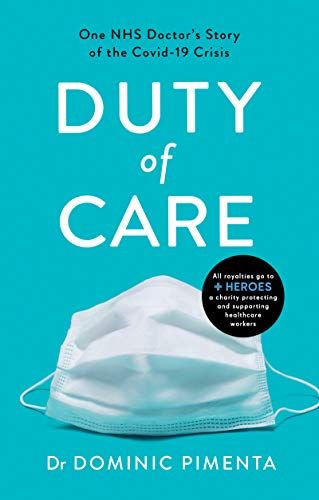
My initial reaction in reading the book was this isn’t a detached policy history of the pandemic. It’s a frontline memoir: a clinician’s-eye account of the UK’s early Covid period, told through lived experience rather than graphs. And I welcome this. Pimenta charts the speed at which normal medicine becomes crisis medicine; the psychological whiplash of walking into hospitals that feel increasingly like disaster zones, and the moral weight of decisions nobody wants to be qualified to make.
As I'm currently back editing another book on Covid for a client, I feel the best way to read this book is as a contemporaneous document: a “this is what it felt like while it was happening” record and this matters, because crises get rewritten in hindsight. 'Duty of Care preserves' the confusion, the adrenaline, the dread, and the grim practicality of trying to keep people alive when the rules keep changing. Day by day. Hour by hour.
Pimenta writes accessibly and urgently, with enough clinical specificity to feel real, but not so much that it turns into a boring textbook one feels compelled to read. The voice is humane and direct. The kind of narrative that tries to do justice to colleagues and patients rather than using them as mere scenery for a heroic arc. For me, that restraint is one of the book’s strengths: it’s not a victory lap; it’s a witness statement. We need these more and more in today's political climate.
At its best, 'Duty of Care' captures the texture of early Covid: the sense that everything is simultaneously too fast (the spread, the admissions, the deaths) and too slow (the systems, the supplies, the decisions). One can feel the fatigue accumulating, the stress becoming baseline, and the way compassion becomes both fuel and liability. Who are the heroes and who are the villains? Ah, do we even know that for sure at the start of 2026?
Plenty of pandemic books veer into either sainthood or cynicism and Pimenta largely (though not totally) avoids both. The courage here doesn’t come wrapped in swelling music; it comes with fear, frustration, gallows humour, and the dull ache of repeated loss. That emotional honesty is what makes the book useful and not just moving.
There’s also a quiet thread of annoyance: not performative rage, but the kind that forms when frontline reality repeatedly collides with institutional inertia. It’s the anger of people who don’t have the luxury of debating whether a fire is “really that bad” while they’re carrying buckets of water to try to quench it.
Now, a core question is, is it an accurate representation of Covid? If you mean, “Is this a fair representation of what it was like for many NHS staff in the early pandemic?” then from talking with colleagues in the UK, yes, in the sense that it’s grounded in first-wave clinical reality and written close to the events themselves (not years later with the balance and gift of a narrative polish). Accounts like this are inherently partial; one doctor, one set of hospitals, one trajectory but that’s not a flaw; it’s the point. As an editor who frequently edits memoirs, I'm all-too-well aware that memoirs don't have to prove the whole truth of something like a pandemic, but it can tell the truth of a lived slice of it.
If you mean, “Does it accurately predict what Covid became?” It couldn’t, because nobody could. And that’s one of the book’s accidental achievements: it details for readers the early-pandemic mindset, when outcomes were uncertain, treatments were evolving, and the future still looked like fog.
The State of Play Today in January 2026
What’s happened since publication and how it changes the reading? Reading 'Duty of Care' now (in 2026) is like opening a time capsule from the “before we knew” era. Several major developments since 2020 radically changed the Covid story: Let me look at just a few of these for context.
1) Vaccines changed the risk landscape
The UK began administering the Pfizer-BioNTech vaccine in December 2020 (famously with Margaret Keenan as the first recipient), and vaccination became the biggest single shift in outcomes and system pressure. (england.nhs.uk)
That doesn’t make the book outdated. Rather, it makes it historically precise. It captures the period when prevention was mostly behavioural (and political), not biomedical. How quickly things changed, eh?
2) “Living with Covid” became official policy
By February 2022, the UK government’s “Living with COVID” strategy removed key legal requirements such as mandatory self-isolation for positive tests (in England), signalling a move from emergency footing to managed endemicity. (House of Commons Library). This reframes the book’s intensity: it reminds you that what later became “background risk” once felt like an incoming meteor.
3) The global emergency phase ended but Covid didn’t
In May 2023, the WHO Emergency Committee process moved Covid away from the “public health emergency of international concern” framing (the WHO statement marks that shift), even as the virus continued circulating and evolving. (World Health Organization) That distinction is important: Duty of Care is about the emergency phase, the period of acute uncertainty and system shock, rather than the long tail of ongoing transmission, repeat infections, and uneven impacts.
4) Accountability and lessons-learned have become formalised
The UK Covid-19 Inquiry has since produced major reports (and continues its work). Its findings have been blunt about early decision-making and preparedness, including criticism of delay and lost time in early 2020, and modelling suggesting a significantly lower death toll with earlier action. (UK Covid-19 Inquiry) This doesn’t “validate” every emotion in the book, but it does provide a wider structural frame for the kinds of frontline frustrations Pimenta describes: staff were often absorbing the consequences of systemic choices made far above them.
The book’s limitations (worth knowing going in)
It’s not a balanced policy debate. If you want a multi-angle account (care homes, education, economic policy, public health ethics, devolved governance), you’ll need other books alongside it. Further, its scope is early-pandemic heavy. Later phases; vaccines, variants, shifting public behaviour, long Covid policy fights etc are largely beyond its publication window, by definition. It’s also emotionally close to events. That’s a strength, but it can also mean you’re reading the heat of the moment rather than a cooled-down synthesis.

'Duty of Care' works as a knowlegeable book because it refuses to let the early pandemic become an abstract historical montage. It brings you back to the frightened, exhausting, high-stakes reality of the NHS frontline when Covid was still new, still poorly understood, and still crashing through systems not designed for that scale of shock.
As a representation of the first-wave experience, it’s compelling and credible not because it claims to be the whole story, but because it’s honest about the piece of the story it can tell. And in the “since then” context of vaccines, policy normalisation, and official inquiries, the book becomes even more valuable as a primary emotional and clinical record of the moment when our modern world tipped. And, it looks like we will be returning to such a world...
©Niall MacGiolla Bhuí, PhD (January 2026).